
EU sugar industry policy
Does the EU Know It Is Killing Its Sugar Industry?
The European sugar industry faces growing pressure from trade agreements, preferential imports and changing agricultural policies. In this article, Patrick Chatenay examines how EU regulations influence the financial sustainability of domestic sugar production and questions whether current policies are compatible with maintaining a viable European sugar industry.
By Patrick Chatenay - published in Sugar Industry International – Sugar Industry 151 (2026) n°4, 266-268
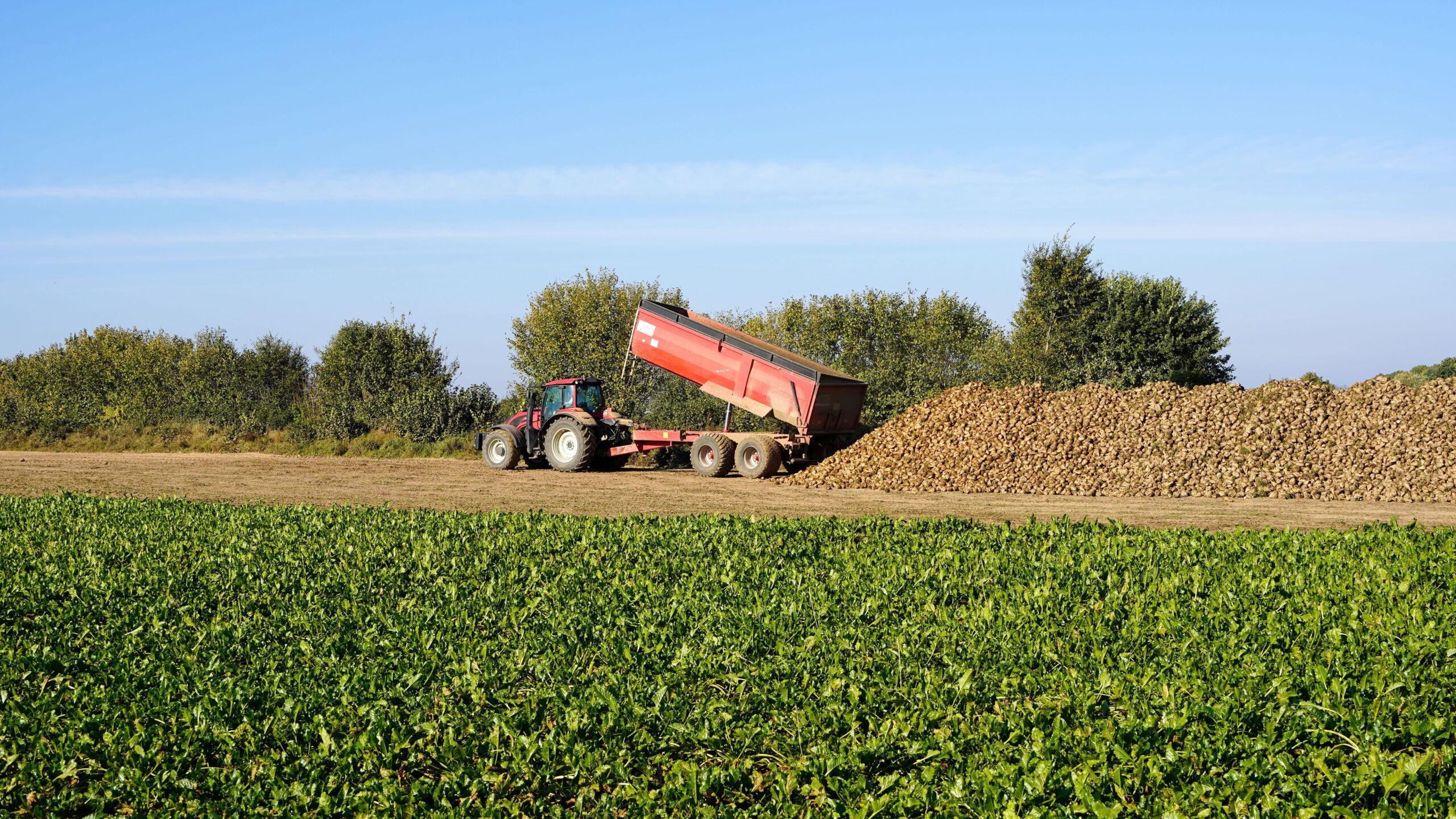
Sugar beet cultivation in europe - a key part of European sugar industry
contents
How does the EU want a domestic sugar supply
Given its capital intensity, a Sugar industry needs both a long-term investment horizon and Security.
Only stable regulations can provide this. No sugar sector is viable at world prices; none has ever been established at world market prices. Indeed, the variability, marginality, and subsidization of the world market sugar price make it a totally unsuitable basis for any sugar industry. Anyone seeking domestic Sugar production must insulate domestic prices from international levels or offer the industry other solid Income sources.
Proven by history and current events, the above statements are indisputable. They are also confirmed by micro-economic models. The world over, a sugar industry's viability is determined by the regulations that govern its revenues.
This is done, for example, in Brazil, where over [percentage to verify] of sugarcane industry income is derived from products other than sugar, essentially energy sales (fuel and electricity). Less than [percentage to verify] of the industry's revenues are derived from Sugar exports: the financial balance of the Brazilian sugarcane industry does not depend on world market prices for sugar.
In the US, the loan rate and the import quotas give a level of security that was abolished in the EU with the end of the quota regime in 2017. In India, the government fixes cane and sugar prices and controls the amounts of sugar imported and exported. For 4 years now, the Australian Sugarcane industry has been asking for government implementation of remunerative access to ethanol and electricity markets.
How does the EU want a domestic sugar supply
Sugar as an essential industrial ingredient
Beyond the spoonful or lump in your tea or coffee, and the occasional home-baked cake, Sugar is mostly an important industrial ingredient for food, chemicals, cosmetics, and pharmaceuticals. Over [percentage to verify] of EU Sugar sales are to industrial Customers. Given sugar's functional properties, changing industrial process formulations is not really an option. Therefore, sufficient access to sugar of high quality is non-negotiable for many industries. American industrial Sugar users have recognized this, as evidenced by their support for the recent increase in the US Sugar loan rate.
The European Union's current Sugar Policy, however, is leading to the slow demise of an industry that can also supply renewable fuels.
The EU's expanding preferential import agreements
Indeed, for over 25 years, the EU has been promoting duty-free Sugar imports. First, it introduced duty-free access for the least developed countries (LDC) in 2001/04, then it converted the ACP quotas into Economic Partnership Agreements (EPA) with unlimited access for sugar. From 2018, it signed Free Trade Agreements with nearly all Latin American countries, which give these countries often limited yearly but increasing access to the EU Sugar market. In addition, the WTO agreement of 1994 provides limited access for Sugar at a duty of €98/t (CXL imports). The Mercosur agreement will give an additional impetus for duty-free Sugar imports. It will shift 180,000 t of Brazilian CXL imports at a duty of €98/t to duty-free, and add 10,000 t duty-free imports from Paraguay. The very recently signed FTA with Australia will add another 35,000 t duty-free and shift 9,925 t from CXL quota to duty-free.
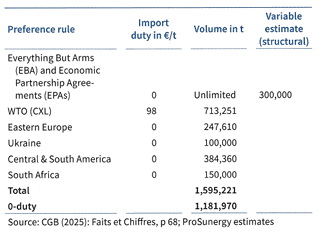
Table 1: Preferential sugar access to the EIJ 2024/25
Figure 1 shows the development of duty-free + €98/t access to the EU, which has increased from less than 1 mn t per year in 2012/13 to over 1.5 mn t per year now.
The impact of preferencial imports on EU sugar prices
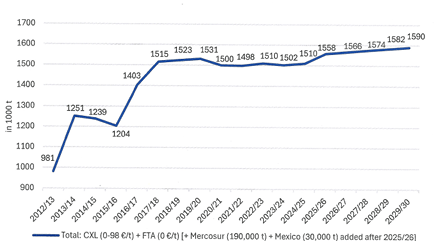
Fig 1: Maximum sugar imports (duty-free and at €9S/t) to the EU market in 1000 t
Thus, the influence of the world price on the EU domestic prices has been growing. In fact, from 2010 to 2025, the average domestic EU refined sugar price was equivalent to the world market price average, once the cost of delivering it to the EU was added. This price level inevitably condemns the industry.
The European authorities' indifference to their domestic Sugar production is clear: the sudden opening of the European market to Ukrainian sugar in 2022/2023 and 2023/2024, European phytosanitary and environmental rules that systematically disadvantage domestic producers, abusive uses of Inward Processing Relief (duty-free imports, if the sugar is re-exported), refusals to increase the authorized proportion of beet-based bioethanol, and successive offers of duty-free sugar and bioethanol import quotas are proof of this.
The desire to facilitate imports is also evidenced by the noticeable weakness of the EU's trade safeguard and defence instruments. The unlimited duty-free, quota-free access negotiated with ACP countries, through EPAs, and LDC countries, through the EBA Initiative, increases world market price transmission. The recent Mercosur-EU FTA will add 180,000 t of Brazilian sugar, and another 10,000 t duty-free from Paraguay, to duty-free imports. To these external pressures, one should add the slow structural decline in domestic sugar demand.
As a result, no new Sugar manufacturing facilities can be built (the failed Belgian Seneffe factory project is telling), 21 factories have been closed over the past 7 years, capacity is being reduced, and European beet growers and sugar companies are suffering financially.
The consequences for European sugar producers
To avoid domestic market prices being uneconomic, EU producers must reduce Output to the point Where duty-paying imports become necessary, i.e. total EU Sugar production duty-free imports must be lower than total EU sugar demand of about the current 15.6 mn t. Today, that means producing less than 14.4 mn t, or about less than in 2025/2026. In this case, there will be a shortage of sugar in the EU, necessitating higher-priced imports, which gives EU producers the opportunity to raise their prices, as shown in Figure 3.
Dynamically, as the EU allocates more duty-free tariff rate quotas in FTAs, the domestic supply by European Sugar manufacturers must trend downwards, and the financial viability is weakened.
Today, there are roughly 1.2 mn t of available duty-free Sugar imports into the EU (Table 1), to which the Mercosur FTA and the Australian FTA will add another 225,000 t. Current manufacturer calls for beet area reductions result from this need to cut domestic production. With some small exceptions, beyond this amount, a €98/t duty applies for another 0.5 mn t.
Since EU market data is widely available, producers, traders, and customers know if tariffed imports are required, and adjust price expectations accordingly.
Thus, without admitting it, and perhaps even without realizing it, the EU is destroying its sugar industry. Is this sensible?
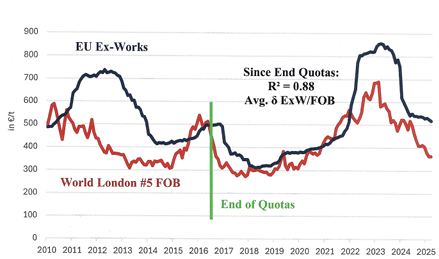
Fig 2: EU prices for white Sugar and London monthty average prices in €/t
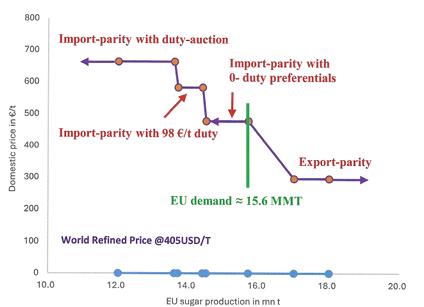
Fig 3: EU sugar price determination
Policy foundations
The shift in EU agricultural and trade policy
With the 1992 Common Agricultural Policy MacSharry reforms, the EU inverted its agricultural support mechanisms. Support moved from high domestic prices to the lowest, roughly import- or export-parity commodity prices, socially buffered by direct, decoupled farm payments.
Although also compelled by other considerations, a justification for such an approach was that it would boost EU-based processing competitivity. It did: EU exports of processed food exploded, helped, too, by "branding" specialities - Parma ham, anyone?
For both food commodities and basic industrial products, the drive to access low-priced imports was vigorously embraced by the EU trade policy. Using low-value ingredient imports to produce high-value exports is a tempting proposition. If foreign competition is unfair, however, this can be fatal for domestic basic-ingredient industries, some of which are quite useful - see steel, for example.
Amongst major economic blocs, the EU's solitary approach to foreign trade is brutally challenged by the proactive policies of China, India, and Brazil, and by the clarity of American agricultural and trade positions.
Sugar supply security : the American approach
It is remarkable that in 2025 American industrial users of sugar strongly supported a material increase in their raw sugar and refined loan rates, to USD 0.24/lb and USD 0.327/lb respectively. For U.S. refined beet sugar, this amounts to a guaranteed price of about €625/t, strikingly above the EU's frankly bizarre sugar official "threshold" reference price of €404/t.
Having experienced COVID-induced disruptions, American industrial users rationally prioritize the safe supply of quality sugar. Food autonomy is as fundamental as is energy autonomy; a domestic Sugar industry provides [sentence appears incomplete in the extracted text — verify against the original PDF].
The EU has long favoured low and unstable import prices to the detriment of domestic employment, sometimes forgetting that income must precede expense, and that the domestic provision of necessities often impacts independence.
The case of a sustainable EU Sugar policy
The EU must ask itself whether it intends to maintain a domestic Sugar supply. If it does, EU Sugar Policy must change. There is no alternative. Like everywhere else, an autonomous Sugar industry can be made viable only through a rational sugar regime.
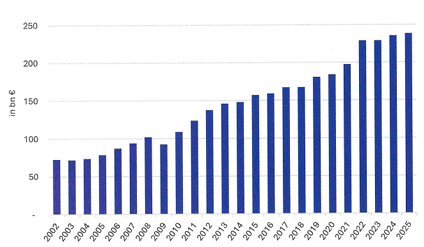
Fig 4: EU Agri-food Exports 2002-2025 in €bn (source agridata.ec.europe)
notes
Original publication :
Originally published in Sugar Industry (2026), pp. 266–268

Written by
Patrick Chatenay
Founder of ProSunergy - In the sugar industry since 1985


Continue reading
Other insights
Reference analysis
Investing in sugar
A short intro
Notes
Trades, subsidies et al.
In the sugar industry, the past matters
Continue reading
Other insights
Notes
Trades, subsidies et al.
Latest : about free trade
Discuss a project with ProSunergy
A question about the sugar industry, an investment or a strategic issue ? Write us